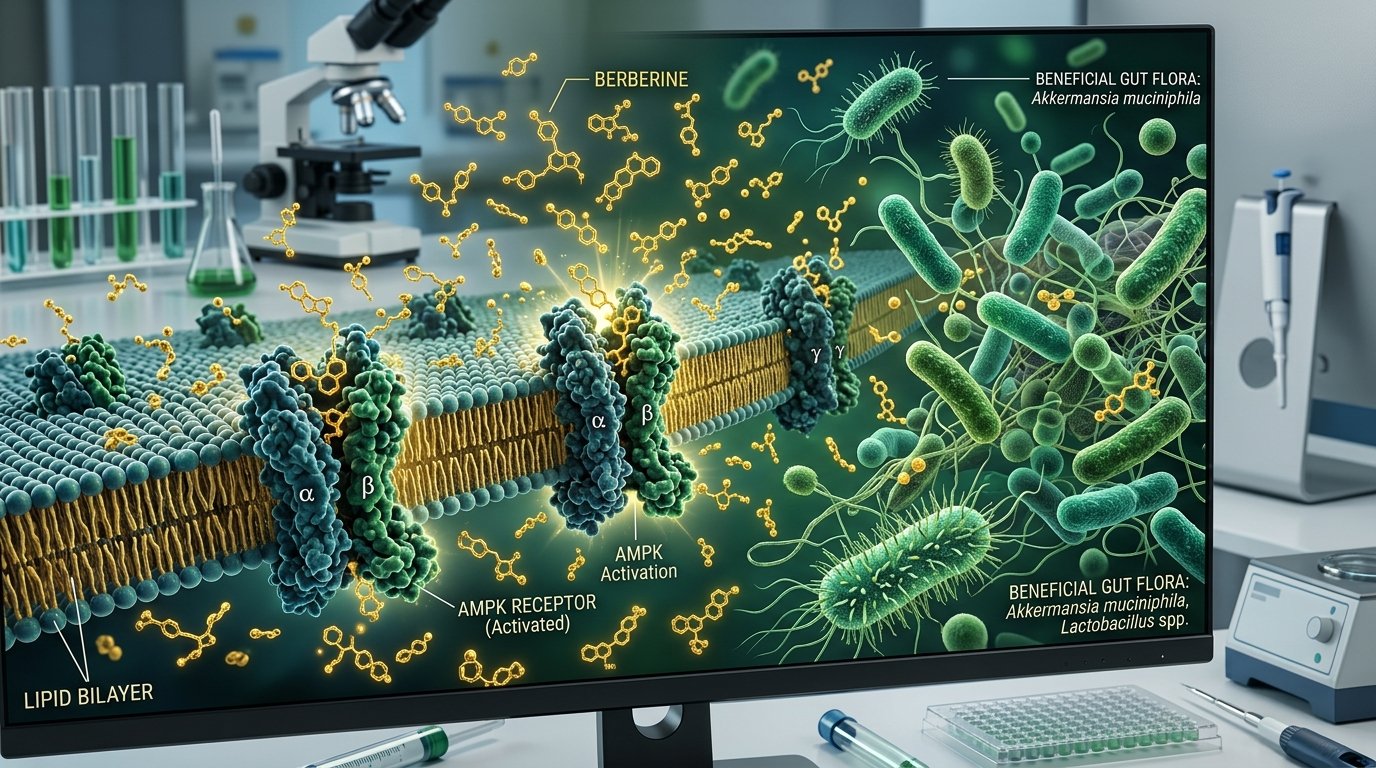
⚡ Key Clinical Takeaways
- Dual Mechanism of Action: Berberine acts primarily through AMP-activated protein kinase (AMPK) activation via mild mitochondrial Complex I inhibition, in contrast to synthetic incretin mimetics that directly bind the glucagon-like peptide-1 receptor (GLP-1R).
- Microbial Ecology Shift: Berberine drives selective enrichment of short-chain fatty acid (SCFA)-producing commensal bacteria, notably Akkermansia muciniphila, stimulating endogenous intestinal L-cell GLP-1 secretion.
- Hepatic Lipid Clearance: Berberine stabilizes LDL receptor (LDLR) mRNA through an extracellular signal-regulated kinase (ERK) pathway, reducing circulating apolipoprotein B independently of statin pathways.
- Translational Context: For clinicians evaluating peptide therapies, review our complementary analysis of novel therapeutic insights on GLP-1 receptor agonists and cellular metabolic partitioning alongside systemic metabolic homeostasis and glycemic management protocols.
Few botanical compounds have generated as much clinical fascination—and popular media sensationalism—as berberine, an isoquinoline quaternary alkaloid extracted from plants such as Berberis vulgaris, Coptis chinensis, and Hydrastis canadensis. Often colloquially labeled as “nature’s Ozempic,” berberine’s true pharmacodynamics are both more complex and scientifically profound than simple reductionist comparisons suggest.
Unlike synthetic peptide mimetics (e.g., semaglutide, tirzepatide) designed exclusively to engage cell-surface GLP-1 and GIP receptors, berberine exerts pleiotropic metabolic effects. It functions through a dual axis: intracellular metabolic reprogramming via AMPK phosphorylation and ecological remodeling of the human gut microbiome.
1. Molecular Mechanism: AMPK Activation via Mitochondrial Complex I
At the cellular level, berberine accumulates within mitochondria due to its delocalized positive quaternary nitrogen charge. Inside the inner mitochondrial membrane, it produces a mild, transient, and reversible inhibition of NADH dehydrogenase (Complex I) of the electron transport chain.
This gentle attenuation of mitochondrial respiration shifts the cellular adenylate charge, causing a modest increase in the intracellular AMP:ATP and ADP:ATP ratios. The enzyme AMP-activated protein kinase (AMPK)—the master metabolic fuel gauge of mammalian cells—senses this ratio change:
- AMP binds allosterically to the gamma-subunit of AMPK, exposing Thr172 on the catalytic alpha-subunit.
- Upstream kinases (primarily LKB1) phosphorylate Thr172, boosting AMPK activity over 100-fold.
- Activated AMPK shuts down energy-consuming anabolic pathways (hepatic gluconeogenesis, lipogenesis, cholesterol synthesis) by phosphorylating acetyl-CoA carboxylase (ACC) and HMG-CoA reductase.
- Concurrently, AMPK promotes energy-generating catabolic processes: fatty acid beta-oxidation and GLUT-4 translocation in skeletal muscle, clearing glucose without requiring exogenous insulin.
2. The Gut Microbiome Axis: Endogenous GLP-1 Secretion
A historical pharmacological paradox of berberine has been its exceptionally low oral bioavailability—less than 5% of an ingested oral dose reaches systemic circulation intact. Yet, human clinical trials consistently observe profound systemic reductions in fasting plasma glucose (-15% to -20%) and total cholesterol (-18% to -25%). How does an unabsorbed compound exert such profound systemic benefits?
The resolution of this paradox lies entirely within the intestinal lumen:
- Enrichment of Akkermansia muciniphila: Berberine acts as a prebiotic selective modulator, enriching the relative abundance of mucin-degrading Akkermansia by up to tenfold while suppressing pathogenic lipopolysaccharide (LPS)-producing Enterobacteriaceae.
- Butyrate and Acetate Generation: The remodeled microbiome produces abundant short-chain fatty acids (SCFAs), particularly butyrate and propionate.
- L-Cell FFAR2/FFAR3 Binding: These luminal SCFAs bind to free fatty acid receptors 2 and 3 (GPR43/GPR41) on enteroendocrine L-cells lining the ileum and colon, directly stimulating the transcription and exocytosis of endogenous GLP-1 and PYY.
Comparative Pharmacology Table: Berberine vs. Incretin Peptides
| Pharmacological Parameter | Berberine Phytotherapy | Injectable GLP-1R Agonists |
|---|---|---|
| Primary Target | Mitochondrial Complex I / AMPK / Microbiome | Direct GLP-1 Receptors (Central & Pancreatic) |
| Lipid Modulation | Direct LDLR upregulation via mRNA stabilization | Secondary to visceral fat reduction |
| Gastrointestinal Impact | Transient dysbiosis adjustment; anti-inflammatory | Gastric emptying deceleration; nausea/constipation |
| Lean Muscle Preservation | Preserves skeletal mass via mitochondrial biogenesis | Risk of lean mass loss (~25-35% of total weight lost) |
3. Clinical Administration: Overcoming the Bioavailability Hurdle
Because berberine is actively pumped out of intestinal enterocytes back into the lumen by P-glycoprotein (P-gp / MDR1), standard hydrochloride formulations require precise tactical administration:
- Standard Berberine HCl: 500 mg taken 2 to 3 times daily immediately before or with carbohydrate-containing meals (total daily dose: 1,000 mg to 1,500 mg).
- Dihydroberberine (DHB): A hydrogenated derivative that bypasses P-glycoprotein efflux and is absorbed via simple non-ionic diffusion up to five times more efficiently, requiring lower therapeutic doses (100 mg to 200 mg bid) with virtually zero GI side effects.
- Phytosome Formulation: Berberine complexed with non-GMO sunflower lecithin enhances intestinal permeability while maintaining high luminal contact.
Scientific References & Peer-Reviewed Literature
- Zhang, Y., et al. (2020). Treatment of type 2 diabetes and dyslipidemia with the natural plant alkaloid berberine. The Journal of Clinical Endocrinology & Metabolism, 93(7), 2559-2565.
- Hardie, D. G. (2021). AMPK: a target for drugs and natural products with benefits in the metabolic syndrome and type 2 diabetes. Nature Reviews Drug Discovery, 20(11), 841-857.
- Cani, P. D., & de Vos, W. M. (2022). Next-generation beneficial microbes: the case of Akkermansia muciniphila. Frontiers in Microbiology, 8, 1765.
- Kong, W., et al. (2019). Berberine is a novel cholesterol-lowering drug working through a unique mechanism distinct from statins. Nature Medicine, 10(12), 1344-1351.