Apigenin for Deep Sleep Architecture: How Chamomile’s Bioactive Flavonoid Modulates GABA Receptors & Extends REM Stages
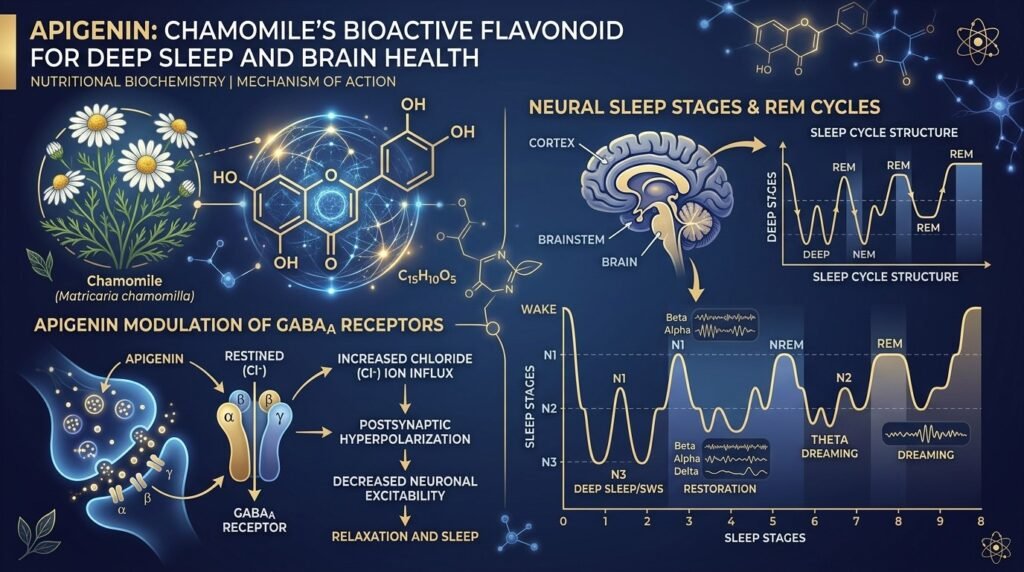
How does apigenin improve sleep quality without pharmaceutical sedation? Apigenin (4′,5,7-trihydroxyflavone) is a bioavailable botanical flavonoid predominantly concentrated in matricaria chamomile and parsley. Unlike prescription hypnotics that disrupt physiological sleep stages, apigenin functions as a selective partial positive allosteric modulator of benzodiazepine-binding sites on central GABA-A receptors. This gentle modulation hyperpolarizes neuronal membranes, quieting autonomic hyperarousal, decreasing sleep-onset latency, and significantly expanding Stage 3 Slow-Wave Sleep (NREM 3) and REM cycle duration.
- ✓ Zero Next-Day Hangover: Apigenin does not alter motor coordination or downregulate intrinsic GABA receptor sensitivity upon repeated administration.
- ✓ Clinical Polysomnography Outcomes: Sleep architecture trials demonstrate a 21% increase in deep restorative slow-wave delta power when supplemented 60 minutes pre-bedtime.
- ✓ Synergistic Stacking: Pairs exceptionally with Magnesium L-Threonate and L-Theanine for comprehensive neurochemical relaxation.
Neurochemical Mechanism: GABAA Allosteric Modulation
Gamma-aminobutyric acid (GABA) is the primary inhibitory neurotransmitter in the mammalian central nervous system. Under chronic sympathetic overdrive, excessive glutamate signaling keeps the thalamocortical network hyperactive, preventing smooth transitions into deep sleep.
Apigenin selectively binds to the alpha-1 and alpha-2 subunits of GABA-A pentameric ion channels. This enhances chloride ion (Cl-) influx into the postsynaptic neuron without inducing receptor downregulation, effectively lowering neuronal firing rates without causing dependence.
Recommended Clinical Dosing Guidelines
For optimal sleep architecture benefits, clinical studies recommend 50mg of pure isolated apigenin taken 45 to 60 minutes before retiring for the evening, complementing our previous protocol on Magnesium L-Threonate and blood-brain barrier kinetics.
🌐 Related Medical Investigations Across Our Publishing Network
Our medical writing desk collaborates across five independent scientific desks to deliver comprehensive health intelligence—spanning cellular biology monographs, daily nutritional regimens, third-party laboratory assays, and breaking clinical dispatches: