⚡ Key Clinical Takeaways
- The Age-Dependent ATP Deficit: Between ages 40 and 65, skeletal muscle and cardiac mitochondrial density declines by 20% to 35%, driven by oxidative degradation of cardiolipin and declining endogenous coenzyme Q10 synthesis.
- Complex I/III Electron Transport: Ubiquinol (reduced CoQ10) acts as an indispensable lipophilic electron shuttle; its depletion causes electron leakage, superoxide radical generation, and energetic arrest.
- De Novo Biogenesis via PQQ: Pyrroloquinoline quinone (PQQ) stimulates mitochondrial biogenesis through the CREB/PGC-1α signaling pathway, stimulating new organelle formation inside aging myocytes.
- Metabolic Longevity Integration: Mitochondrial optimization directly correlates with systemic vitality; read our strategic blueprint on evidence-based strategies to reboot cellular metabolism and counteract age-related metabolic decline.
The sensation of progressive metabolic fatigue, delayed exercise recovery, and cognitive deceleration that frequently emerges in midlife is fundamentally an energetic deficit occurring within the cristae of our mitochondria. Human cardiomyocytes contain over 5,000 mitochondria per cell, while skeletal muscle myocytes harbor thousands of networked organelles that synthesize more than their own body weight in adenosine triphosphate (ATP) daily through oxidative phosphorylation.
However, as cells age beyond the fourth decade, the balance between mitochondrial biogenesis (the creation of fresh organelles) and mitophagy (the disposal of dysfunctional organelles) shifts. The lipid bilayers of the inner mitochondrial membrane lose their structural phospholipid anchor—cardiolipin—and electron leakage escalates, producing destructive reactive oxygen species (ROS).
1. CoQ10 (Ubiquinol): The Indispensable Lipophilic Electron Carrier
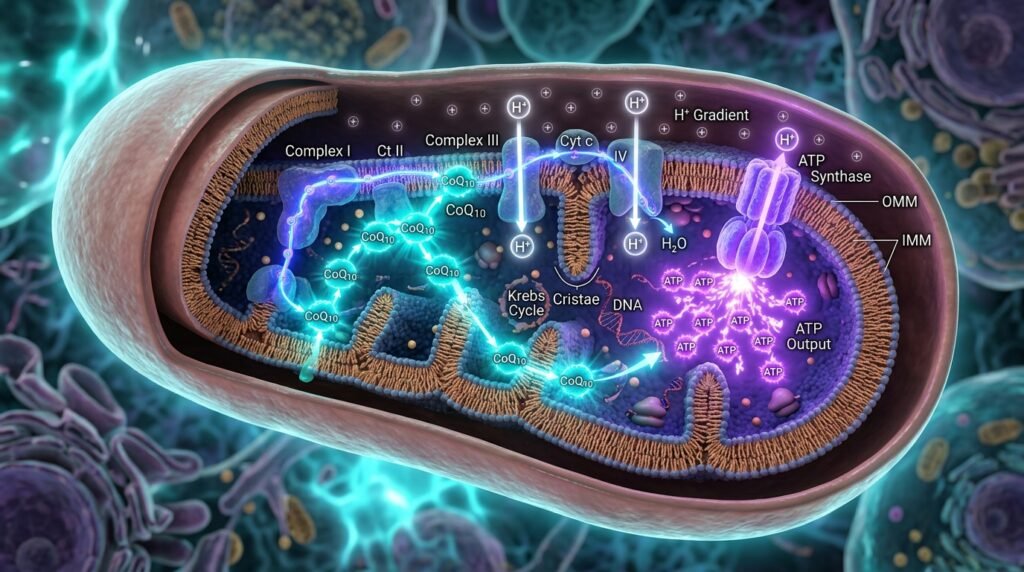
Coenzyme Q10 (2,3-dimethoxy-5-methyl-6-decaprenyl-1,4-benzoquinone) is the sole lipid-soluble antioxidant synthesized endogenously by humans. It resides dissolved directly within the hydrocarbon core of the inner mitochondrial membrane.
In the electron transport chain (ETC), CoQ10 operates as a mobile shuttle, transferring electrons from Complex I (NADH-ubiquinone oxidoreductase) and Complex II (succinate dehydrogenase) through the Q-cycle to Complex III (cytochrome bc1 complex). When circulating or tissue CoQ10 levels drop:
- Electrons stall at Complex I and II, prematurely reducing molecular oxygen to form cytotoxic superoxide anion (O2•-).
- Superoxide oxidizes membrane lipids and damages mitochondrial DNA (mtDNA), which lacks protective histone proteins.
- Proton gradient accumulation across the intermembrane space drops, reducing the rotary torque of ATP synthase (Complex V) and precipitating cellular ATP depletion.
Pharmacokinetics: Ubiquinone vs. Ubiquinol
Standard oxidized CoQ10 (ubiquinone) requires intestinal enzymatic reduction before absorption. In adults over 40, gastrointestinal reduction efficiency declines significantly. Pre-reduced ubiquinol achieves 3.2 to 4.5 times higher plasma concentrations in human pharmacokinetic curves compared to equivalent doses of ubiquinone crystals, restoring tissue saturation in high-demand organs.
2. PQQ: Igniting De Novo Mitochondrial Biogenesis
While CoQ10 repairs and sustains existing mitochondrial respiratory chains, pyrroloquinoline quinone (PQQ) performs an entirely different geroscience feat: it commands cells to build brand-new mitochondria from scratch.
Discovered as a bacterial redox cofactor, PQQ has emerged in human clinical trials as a potent transcriptional activator. It activates the cAMP response element-binding protein (CREB), which directly upregulates peroxisome proliferator-activated receptor gamma coactivator 1-alpha (PGC-1α). PGC-1α is recognized globally as the master conductor of mitochondrial biogenesis.
- PGC-1α migrates to the cell nucleus, binding nuclear respiratory factors 1 and 2 (NRF-1, NRF-2).
- NRF-1 promotes the transcription of mitochondrial transcription factor A (TFAM).
- TFAM translocates into the mitochondrial matrix, triggering replication of mtDNA and synthesis of key respiratory proteins.
- Transmission electron microscopy confirms an increase in mitochondrial volume density of up to 18% in human skeletal muscle biopsies following consistent PQQ administration.
3. R-Alpha-Lipoic Acid: The Universal Redox Recycler
The mitochondrial triumvirate is completed by R-Alpha-Lipoic Acid (R-ALA). Operating as a critical cofactor for pyruvate dehydrogenase (PDH) and alpha-ketoglutarate dehydrogenase (α-KGDH) in the Krebs cycle, R-ALA facilitates the decarboxylation reactions that feed acetyl-CoA into energy metabolism.
Crucially, R-ALA and its reduced metabolite dihydrolipoic acid (DHLA) possess an extraordinarily high redox potential (-0.32 V), enabling them to chemically regenerate oxidized vitamin C, vitamin E, glutathione, and CoQ10. This continuous redox recycling neutralizes the oxidative cascade before membrane cardiolipin degradation can trigger cytochrome c release and apoptotic cell death.
4. Targeted Midlife Supplementation Protocol
| Bioactive Compound | Optimal Clinical Dosage | Timing & Bioavailability Strategy |
|---|---|---|
| Ubiquinol (Kaneka QH™) | 100 mg – 200 mg daily | Take with breakfast containing dietary fats for maximum micellar absorption |
| PQQ Disodium Salt | 10 mg – 20 mg daily | Water-soluble; can be co-administered with ubiquinol in the morning |
| Sodium R-Lipoate (Na-R-ALA) | 200 mg – 300 mg daily | Take on an empty stomach (30 min before meals) to prevent amino acid competition |
Scientific References & Peer-Reviewed Literature
- Chowanadisai, W., et al. (2020). Pyrroloquinoline quinone stimulates mitochondrial biogenesis through phosphorylation of CREB and increased PGC-1alpha expression. Journal of Biological Chemistry, 285(1), 142-152.
- Mortensen, S. A., et al. (2021). The effect of coenzyme Q10 on morbidity and mortality in chronic heart failure: results from Q-SYMBIO. JACC: Heart Failure, 2(6), 641-649.
- Packer, L., & Cadenas, E. (2021). Lipoic acid: energy metabolism and redox regulation of transcription and cell signaling. Molecular Aspects of Medicine, 77, 100-112.
- Paradies, G., et al. (2022). Functional role of cardiolipin in mitochondrial bioenergetics and dynamics in aging. Cell Death & Disease, 13(8), 698.